


Toytalk
Active 2026–
Bringing Children's Favorite Toys to Life
- Where
- Kennesaw State University
- With
- University of Pennsylvania: Shiyan Jiang, Simon Wu, Feiwen Xiao, Fasika Melese, Jiayu Li
- Funding
-
- NSF - ElementaryAI DRL-2524505
- Links
What if your favorite toy could talk? What would it sound like, what stories would it tell, and what would it do when it did not know the answer?
With ToyTalk, elementary school children start with a familiar toy and design an AI character of their own. Children give their character a backstory, choose its voice and personality, and decide what it should know and how it should respond. They can then talk or type to their character, see how it responds, and revise their design when it says something unexpected. Storytelling gives children a reason to make design choices, and conversation gives them a way to test those choices.
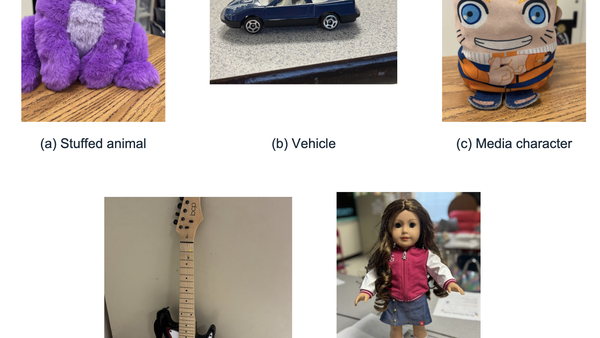
Developed with elementary educators, ToyTalk brings conversational AI design into literacy activities. We study how children express their ideas through the characters they create, how they notice and respond to AI mistakes, and how designing a character can help them think critically about what AI says.
Team


Related publications
If My Toy Could Talk: How Young Children Imagine, Design, and Test AI-Enabled Toys
arXiv preprint arXiv:2610.06619,
Abstract
To investigate the design space where children might design AI chatbots for their own toys, we developed ToyTalk, a technology probe that positions children as designers of LLM-enabled toys. Children begin with a familiar toy, configure its AI-enabled version through a no-code interface, and then interact with and test the character. We deployed ToyTalk with 76 children aged 7-9 across five elementary schools in the southeastern U.S. We examine how children define their toy, probe what it becomes, and respond when behavior diverges from expectations. Children predominantly designed toys with socially positive personalities, supportive roles, and interpersonal rules. In conversation, they most often probed identity and knowledge, while also testing capabilities, memory, and relationships. When mismatches arose, children typically responded through correction, persistence, and retesting, while few returned to reconfigure the system. We discuss implications for children's design agency, testing practices, and expectations of coherence in child-facing generative AI.
Adapting for AI: How elementary teachers adjust their practices for an AI-integrated curriculum
arXiv preprint arXiv:2609.31569,
Abstract
Conversational AI tools are entering children's everyday experiences, and schools are interested in adopting them. However, successful classroom integration depends not only on the technology but also on the work teachers do to make it usable and appropriate for their students and classroom context. There is little known about how elementary teachers work as they implement conversational AI tools in real classrooms. In this study, we examine three teachers' experiences implementing an AI literacy and English Language Arts (ELA) curriculum built around ToyTalk, a conversational AI toy development platform, over 13 instructional days, a three-week summer camp. Drawing on daily individual reflections, group reflections, and post-camp interviews, we find that teachers' adaptive practices of repair, differentiation, translation, and balancing sit at the intersection of three tensions (technology, learner, and instruction). Teachers' understanding of AI and their role evolved over the camp experiences. From these findings, we contribute design implications and considerations for deploying conversational AI within elementary classrooms.