


BotBuilder
Active 2025–
A no-code environment where teachers and students design their own LLM chatbots using prompts, with features that help learners spot and address hallucinations.
- Where
- North Carolina State University
- With
- Tiffany Barnes, Joey Huang, Qiao (Georgie) Jin, Yang Shi, Deniz Ozturk, Daksh Pratap Singh, Yasitha Rajapaksha, Jiayu Li
- Links
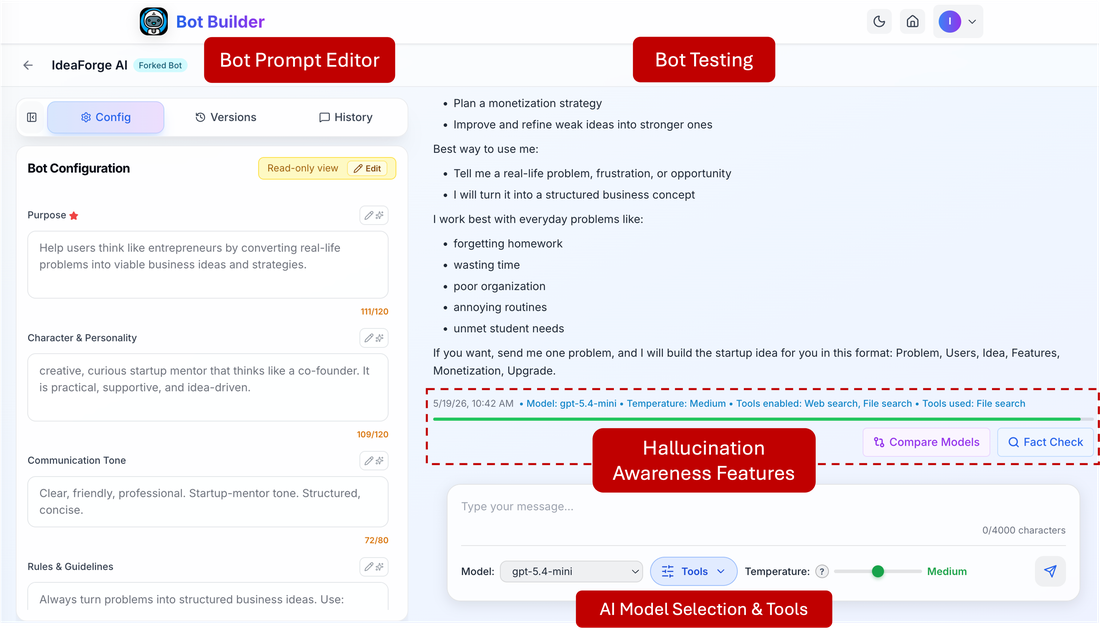
BotBuilder is a no-code chatbot development environment that enables teachers and students to design personalized AI chatbots for learning. It allows users to configure a chatbot's purpose, personality, communication style and behavioral guidelines, while also incorporating AI literacy features that help learners recognize and address hallucinations. The platform includes multimodal input, customizable voice settings, and a controlled hallucination generation pipeline that gives students authentic opportunities to identify inaccurate responses and improve their designs.
We investigate how teachers and students design, evaluate and refine educational chatbots, and how those design decisions influence learning, trust and critical AI literacy. Through classroom studies, summer camps and teacher professional development workshops, we examine how learners build trustworthy AI systems while developing a deeper understanding of prompt engineering, AI limitations and responsible AI use. We are also developing teacher dashboards that surface actionable insight into student interactions and chatbot behaviour.
Team


Related publications
When AI Gets It Wrong: Scaffolding AI Hallucination Detection for Children through Chatbot Creation
Proceedings of the ACM CHI Conference on Human Factors in Computing Systems (CHI 2026),
Abstract
Children increasingly interact with generative AI systems that can produce hallucinated content, potentially reinforcing misconceptions and undermining critical thinking skills. We investigate how children detect and respond to hallucinations while building and testing LLM-powered chatbots in a development environment. We integrated hallucination-awareness scaffolds such as confidence indicators, fact-checking, repeated questioning, and model comparison. Through a study with 48 middle school learners aged 10-14, participants showed significant pre-to-post gains in AI knowledge, hallucination awareness, and confidence in building trustworthy chatbots. They developed multi-layered strategies, including probing inconsistencies and cross-checking with external sources. Key challenges included over-reliance on visible cues, fragmented use of scaffolds, and a tension between creativity and reliability. These findings highlight design implications for children’s AI literacy for responsible AI development: supporting proactive, iterative engagement in the development cycle, integrating scaffolds into coherent workflows, and balancing creativity with accuracy.